

The Turkey eVisa requires a passport valid for at least 60 days beyond your stay, a working email address, and a credit or debit card enabled for 3D Secure international transactions. Citizens of over 100 countries can apply online at the official portal evisa.gov.tr in approximately 3 minutes. This guide covers every document, condition, and nationality-specific requirement you need to complete a successful Turkey eVisa application.
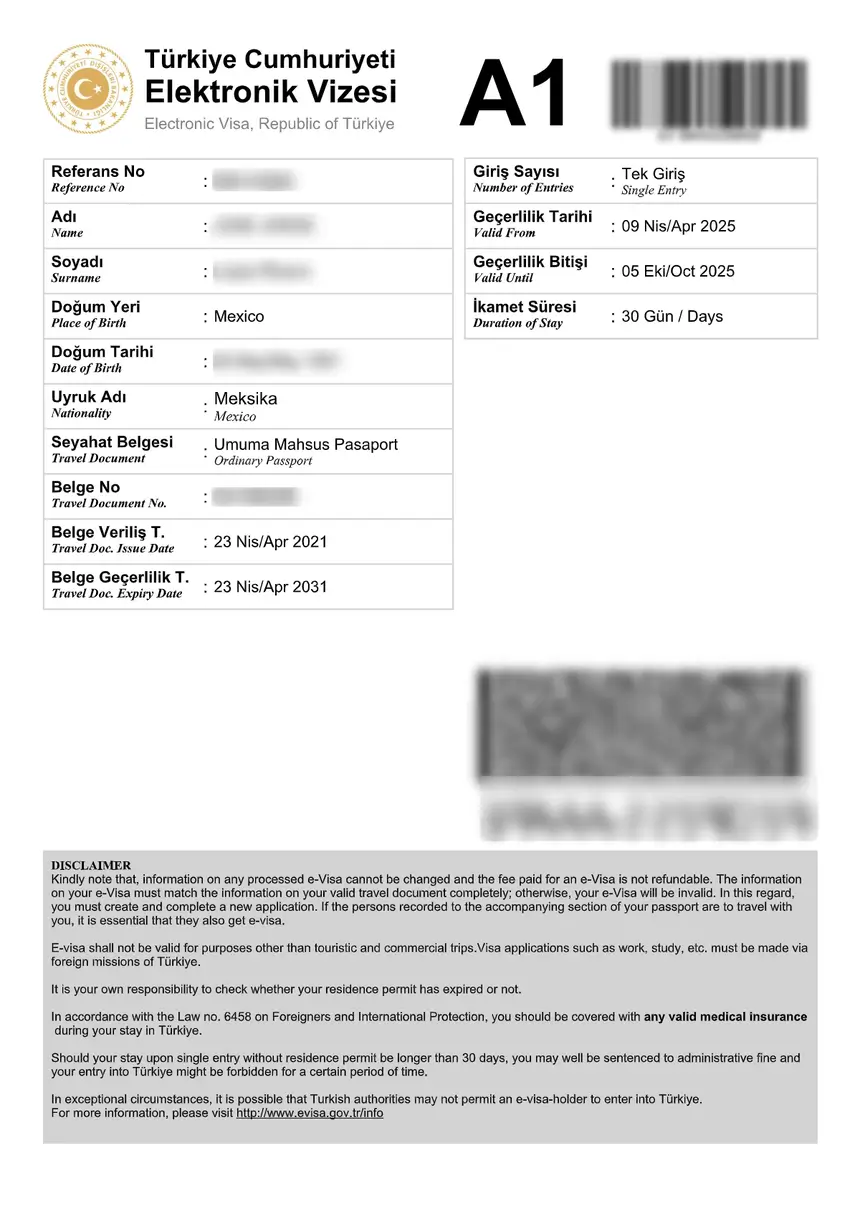
What Documents Do You Need for a Turkey eVisa?
Turkey eVisa requirements consist of three mandatory documents for all applicants: a valid passport, a working email address, and an internationally-enabled payment card. Additional supporting documents may apply depending on your nationality, but these three form the universal foundation of every application.
The Turkey eVisa application portal at evisa.gov.tr – the only government-authorized website run by the Ministry of Foreign Affairs of the Republic of Turkiye – requires the following at the time of submission:
- Valid passport: Your travel document must meet specific validity requirements set by Turkish law. The passport number, expiry date, and full name must match exactly what appears on your travel document.
- Email address: A working email is mandatory to receive the verification link and the approved eVisa PDF document. The system sends an approval request that must be acted on within a strict time window.
- Payment card: A credit or debit card from Visa, Mastercard, UnionPay, American Express, JCB, Diners Club, or Discover. The card does not need to be in your name, but it must support 3D Secure authentication and be enabled for international transactions in US Dollars.
Certain nationalities require additional supporting documents beyond these three core requirements. These may include a round-trip ticket, hotel reservation, proof of sufficient funds, or a valid visa from a Schengen country, the United States, the United Kingdom, or Ireland. The system displays nationality-specific requirements after you select your country during the application process.
Important: Each traveler must obtain a separate Turkey eVisa, including infants and children listed on a parent’s passport. There are no exceptions to this rule.
Turkey eVisa Passport Validity Requirements
Turkish law requires your passport to be valid for at least 60 days beyond the duration of stay authorized by your eVisa, as established by Article 7.1b of the Law on Foreigners and International Protection No. 6458. This is a legal requirement, not a recommendation, and border officers enforce it at all ports of entry.
The 60-day rule works as follows – add 60 days to your authorized stay duration to calculate the minimum passport validity needed at the time of entry:
| eVisa Stay Duration | Minimum Passport Validity | Calculation |
|---|---|---|
| 90 days | 150 days from entry | 90 + 60 |
| 60 days | 120 days from entry | 60 + 60 |
| 30 days | 90 days from entry | 30 + 60 |
For example, if your Turkey eVisa authorizes a 90-day stay – the most common duration for US and UK citizens – your passport must be valid for at least 150 days (approximately 5 months) from your date of entry into Turkiye.
The Ministry of Foreign Affairs additionally advises all travelers to carry a passport valid for at least 6 months from the date of arrival, even though the legal minimum is calculated using the 60-day formula above. Airlines and border officials may apply the 6-month guideline more strictly than the legal minimum.
Exempted categories: Citizens of countries allowed to enter Turkiye with national ID cards under the European Agreement on Regulations governing the Movement of Persons, and holders of diplomatic and official passports, are exempt from the 60-day passport validity provision.
Payment Requirements and Accepted Cards
The Turkey eVisa fee must be paid in US Dollars using a credit or debit card that supports 3D Secure authentication and international transactions. Payment is processed exclusively through the evisa.gov.tr portal, and the fee is non-refundable once the eVisa is issued.
The following payment networks are accepted for Turkey eVisa applications:
| Payment Network | Type | 3D Secure Required |
|---|---|---|
| Visa | Credit/Debit | Yes |
| Mastercard | Credit/Debit | Yes |
| UnionPay | Credit/Debit | Yes |
| American Express | Credit | Yes |
| JCB | Credit | Yes |
| Diners Club | Credit | Yes |
| Discover | Credit | Yes |
Key payment rules for the Turkey eVisa:
- The fee is charged in US Dollars (USD) only. You do not need a USD-denominated account – your bank automatically deducts the equivalent amount in your local currency.
- The card does not need to be in your name – a family member or travel companion’s card is acceptable.
- Your card must have 3D Secure enabled. If your payment is declined, contact your bank to verify that 3D Secure and international transactions are activated.
- After email verification, you have 48 hours to complete payment. If the payment window expires, your application is cancelled and you must start over.
- The online eVisa fee is lower than the visa on arrival fee available at Turkish airports.
Nationality-Specific Requirements for the Turkey eVisa
While citizens of over 100 countries are eligible for the Turkey eVisa, the specific requirements – including fees, validity periods, and supporting documents – vary significantly by nationality. Some nationalities can apply with only a passport and payment card, while others must present additional qualifying documents.
Standard eligibility (passport + payment card only):
Citizens of the United States, United Kingdom, Canada, Australia, and most European countries typically need only the three core documents. The application process displays the fee and validity period immediately after you select your nationality on evisa.gov.tr.
Conditional eligibility (additional documents required):
Citizens of certain countries – including Afghanistan, Algeria, Bangladesh, Egypt, India, Pakistan, and the Philippines – must hold a valid supporting document in addition to their passport. Accepted qualifying documents include:
- A valid Schengen visa or residence permit
- A valid United States visa or residence permit
- A valid United Kingdom visa or residence permit
- A valid Ireland visa or residence permit
Without one of these qualifying documents, citizens of conditional-nationality countries cannot obtain a Turkey eVisa and must apply through a Turkish embassy or consulate instead.
Visa-exempt nationalities:
Citizens of certain European, South American, and Central Asian countries do not need any visa at all. They can enter Turkiye with just a national ID card or passport for stays of 30 to 90 days within a 180-day period. Examples include Germany, France, Brazil, Argentina, and most EU member states.
To verify your specific nationality requirements, visit evisa.gov.tr, click “Apply,” and select your country or region of travel document. The system immediately displays your eligibility status, applicable fee, and any additional document requirements.
Email Verification and Application Timeline
After submitting your Turkey eVisa application, you must click the email verification link within 1 hour and complete payment within 48 hours, or your application expires permanently. These deadlines are enforced by the system with no extensions or exceptions.
The Turkey eVisa application follows this strict timeline:
- Application submission: Fill in personal details, passport information, and travel dates on evisa.gov.tr
- Email verification (within 1 hour): Click the “Approve” button in the verification email sent to your registered address. If you do not click within 1 hour, the application times out.
- Payment (within 48 hours of verification): Complete the fee payment using an accepted card with 3D Secure. If you do not pay within 48 hours, the application expires.
- eVisa delivery: After successful payment, the eVisa PDF is emailed to you immediately and is also available for download on the portal.
Critical rules about the Turkey eVisa timeline:
- You can apply up to several months before your travel date. The eVisa has a validity period during which you must enter Turkiye.
- Once the eVisa is processed and issued, none of the information can be changed. If your passport details, name, or dates contain errors, the eVisa is invalid with no refund.
- You may enter Turkiye at any time within the eVisa’s validity period, but you cannot arrive earlier than the date specified on your eVisa without creating a new application.
- If you encounter suspended or unsuccessful transactions, contact the e-Visa Support Desk before creating a new application. Additional payments for the same application will not be refunded.
Supporting Documents for Certain Nationalities
Applicants from countries requiring supporting documents must provide proof of onward travel, accommodation, and sufficient financial funds in addition to their passport and a qualifying Western visa. These Turkey eVisa requirements apply specifically to nationalities designated as conditional by the Turkish Ministry of Foreign Affairs.
The standard supporting documents for conditional-nationality applicants include:
- Round-trip or onward travel ticket: Proof that you plan to leave Turkiye before your eVisa expires. A confirmed airline booking or travel itinerary is acceptable.
- Hotel reservation: Confirmation of accommodation for the duration of your stay. This can be a hotel booking, Airbnb confirmation, or a letter of invitation from a host in Turkiye.
- Proof of sufficient funds: Border officials may request evidence that you can support yourself financially during your stay. The commonly cited guideline is approximately $50 USD per day of your planned stay.
- Valid Schengen, US, UK, or Ireland visa: This is the qualifying document that makes conditional nationalities eligible for the eVisa rather than requiring an embassy visa. The qualifying visa must be valid at the time of your Turkey eVisa application and your entry into Turkiye.
These supporting documents are not uploaded during the online application process but may be requested by passport control officers at Turkish airports and border crossings. Carry printed copies alongside your eVisa PDF to avoid complications at the port of entry.
Turkey eVisa vs Visa on Arrival – Which Requirements Apply?
The Turkey eVisa and the visa on arrival serve the same purpose but differ in cost, convenience, and availability – the eVisa has lower fees and can be obtained before travel, while the visa on arrival costs more and is only available at Turkish airports. Understanding the differences helps you choose the right option for your Turkey eVisa requirements.
| Feature | Turkey eVisa | Visa on Arrival |
|---|---|---|
| Where to apply | Online at evisa.gov.tr | Turkish airport immigration |
| Fee | Lower (varies by nationality) | Higher than online rate |
| Processing time | ~3 minutes online | Varies (queue dependent) |
| Availability | 24/7, any location with internet | Only at Turkish airports |
| Payment | Credit/debit card (7 networks) | Cash or card at airport |
| Advance preparation | Apply days/weeks before travel | Apply on arrival |
The eVisa is the recommended option for all eligible travelers. The Ministry of Foreign Affairs specifically encourages online applications because the fees are lower than airport-issued visas, and the process eliminates uncertainty at the port of entry. Having your eVisa approved before departure means you proceed directly to passport control upon arrival in Turkiye.
Exception: If you are already at a Turkish airport without an eVisa, the visa on arrival remains available for eligible nationalities. However, this should be treated as a backup option, not the primary application method.
Family and Group Application Requirements
Turkey eVisa applications can be submitted for individuals, families of 2 to 10 people, or groups of 10 to 300 people through a single online submission, but every traveler must receive a separate eVisa document. This includes infants and children, even if they are listed on a parent’s passport.
Individual applications are the standard option for solo travelers or couples. Each person submits their own passport details, email address, and payment information.
Family applications (2-10 people): A single application covers all family members traveling together. The primary applicant enters details for each family member, including:
– Full name and surname (exactly as on passport)
– Date of birth
– Passport number and expiry date
– Nationality
Each family member receives their own separate eVisa PDF. Payment can be made in a single transaction covering all family members.
Group applications (10-300 people): Designed for tour groups, business delegations, and organized travel parties. A group coordinator submits all member details through the evisa.gov.tr portal and can make a lump-sum payment. Each group member receives an individual eVisa.
Key rule: Every person entering Turkiye – regardless of age – must have their own Turkey eVisa. Children and infants cannot travel on a parent’s eVisa, even if the child is included in the parent’s passport.
Common Reasons for Turkey eVisa Application Rejection
Turkey eVisa applications fail most often due to mismatched passport details, expired documents, payment failures, and unverifiable email addresses. Understanding these common pitfalls helps you avoid delays and ensure your application succeeds on the first attempt.
The most frequent causes of Turkey eVisa application issues include:
- Name mismatch: The name entered in the application must match your passport exactly. Even small differences – such as a missing middle name or different spelling – can render the eVisa invalid.
- Passport expiry: If your passport does not meet the 60-day validity requirement calculated from your stay duration, the system will reject your application or the eVisa will be invalid at the border.
- Payment failure: Cards without 3D Secure enabled, cards blocked for international transactions, or insufficient funds will cause payment to fail. Contact your bank before applying if you are unsure.
- Email verification timeout: Failing to click the verification link within 1 hour means your application times out. Check your spam folder if the email does not arrive within a few minutes.
- Payment timeout: After email verification, you have exactly 48 hours to pay. Missing this deadline means starting over.
- Incorrect passport number: A single wrong digit in the passport number creates a mismatch that invalidates the eVisa. Double-check before submitting.
Once the Turkey eVisa is processed, no information can be changed. There is no amendment, correction, or refund process. If your eVisa contains errors, you must apply for a new one and pay the fee again.
Frequently Asked Questions (FAQ)
What documents are needed for a Turkey eVisa?
The Turkey eVisa requirements include three mandatory documents: a valid passport, a working email address, and a credit or debit card supporting 3D Secure international transactions. Depending on your nationality, you may also need a round-trip ticket, hotel reservation, proof of funds, and a valid Schengen, US, UK, or Ireland visa.
Do US citizens need an eVisa for Turkey in 2026?
Yes, US citizens need a Turkey eVisa for tourism or business visits. The eVisa for US citizens costs approximately $50 USD, allows multiple entries, and permits a stay of up to 90 days within a 180-day validity period. US citizens do not need supporting documents beyond a valid passport and payment card.
How early should I apply for a Turkey eVisa?
You can apply for a Turkey eVisa at any time before your trip. The eVisa has a validity period, and you must enter Turkiye within that window. Applying at least 1-2 weeks before departure is recommended to allow time for any issues with email verification or payment processing.
How long does my passport need to be valid for a Turkey eVisa?
Your passport must be valid for at least 60 days beyond your authorized stay duration, per Article 7.1b of Law No. 6458. For a 90-day stay, this means 150 days of validity from your entry date. The Ministry of Foreign Affairs recommends 6 months validity as a general guideline.
What payment methods are accepted for the Turkey eVisa?
The Turkey eVisa accepts Visa, Mastercard, UnionPay, American Express, JCB, Diners Club, and Discover. All cards must support 3D Secure authentication and be enabled for international transactions in US Dollars. The card does not need to be in the applicant’s name.
Can Pakistani citizens get a Turkey eVisa?
Pakistani citizens may be eligible for the Turkey eVisa depending on their passport type and whether they hold a valid Schengen, US, UK, or Ireland visa or residence permit. Without a qualifying Western visa, Pakistani passport holders must apply through a Turkish embassy or consulate.
Do children need a separate Turkey eVisa?
Yes, every traveler including infants and children must have their own individual Turkey eVisa, even if the child is listed on a parent’s passport. There are no age exemptions. Families of 2-10 people can submit a single family application through evisa.gov.tr.
Can I apply for a Turkey eVisa at the airport?
The Turkey eVisa is an online-only application at evisa.gov.tr and cannot be started at the airport. However, a visa on arrival is available at Turkish airports for eligible nationalities at a higher fee than the online eVisa. It is strongly recommended to apply online before traveling.
What happens if my Turkey eVisa application is rejected?
If your Turkey eVisa application fails due to payment issues or email timeout, you can start a new application. If the eVisa is issued but contains incorrect information, it cannot be changed or refunded – you must apply and pay again. Contact the e-Visa Support Desk through evisa.gov.tr for transaction-related issues.
Is 3D Secure required for the Turkey eVisa payment?
Yes, 3D Secure authentication is mandatory for all Turkey eVisa payments. If your card does not support 3D Secure, the payment will be declined. Contact your bank to enable 3D Secure on your card before applying, or use an alternative card that has this feature activated.